Handstand
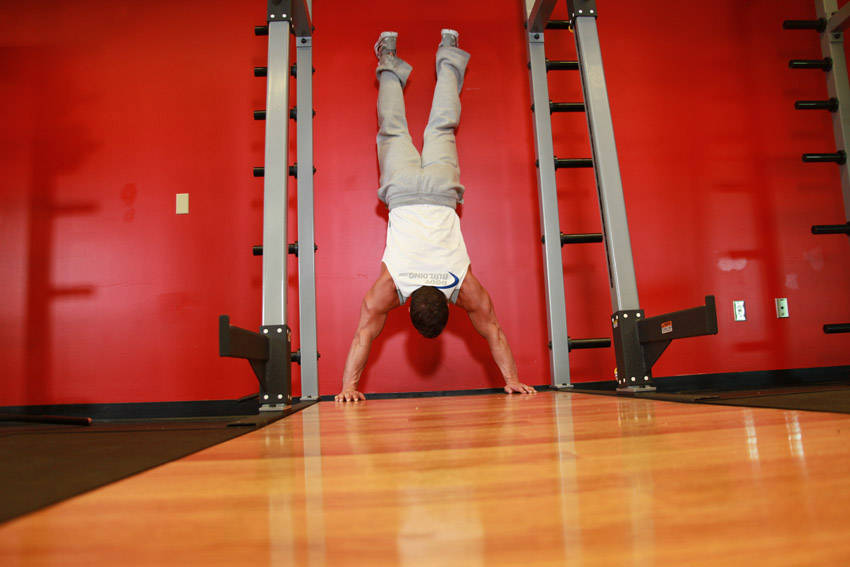
An advanced balance and strength skill where the body is held upside down supported only by the hands and arms.
Instructions
- Begin by practicing against a wall for safety and balance assistance.
- Place hands on the floor about shoulder-width apart, fingers spread wide for stability.
- Kick one leg up toward the wall while pushing off with the other leg and hands.
- Allow both legs to extend upward against the wall, getting your body into a vertical position.
- Keep your body tight with a slight arch, engaging your core and shoulders.
- Hold this position for as long as possible, breathing steadily.
- Slowly lower your feet back to the starting position.
Tips
- Wall practice is essential for developing balance and confidence before free-standing attempts
- Keep wrists and shoulders strong by practicing regularly
- Maintain a slight body arch to improve balance and reduce shoulder strain
- Tighten your core to stabilize your position
- Progress to free-standing handstands only when wall holds feel solid and comfortable
Recommended starting values
Sensible novice starting points for each goal, for a lifter aged 25–40. Scale down for smaller frames or older lifters. Treat the first set of any session as a discovery set.
| Goal | Sets | Hold |
|---|---|---|
| Gain strength | 3 | 5 s |
| Build muscle | 3 | 10 s |
| Build endurance | 3 | 15 s |
Alternatives
Exercises that target the same muscles with the same force and mechanic.
expert calisthenics
Handstand Shoulder Tap
Learn more about handstand shoulder tap expert calisthenics